Most ASO case studies come from agencies working on large apps. These 40, counted in the November 3 version of our dataset (419 cases), come from one developer each, mostly from their own blogs, and 37 of the 40 were published by people with no ASO product to sell. They’re the closest public comparison for an indie app. Every one is in our open dataset with its source.
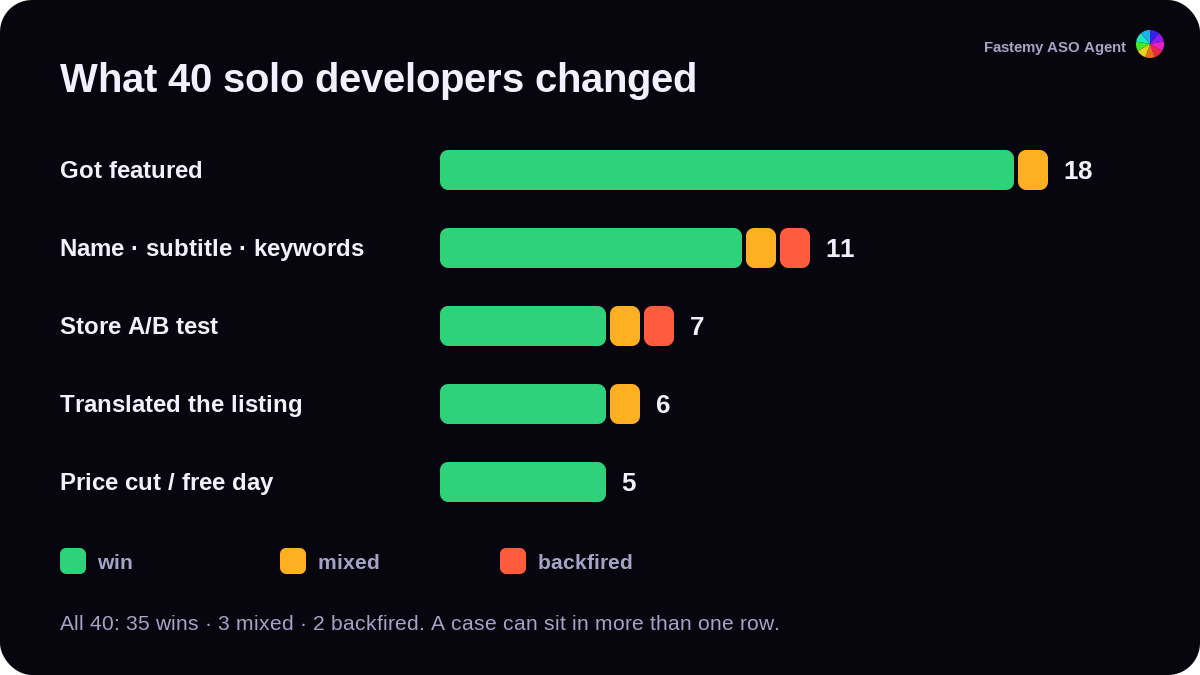
What 40 solo developers changed
| Change | Cases | Result |
|---|---|---|
| Got featured by Apple or Google | 18 | 17 wins, 1 mixed |
| Rewrote the name, subtitle or keyword field | 11 | 9 wins, 1 mixed, 1 backfired |
| Ran a store A/B test (screenshots, icon, description) | 7 | 5 wins, 1 mixed, 1 backfired |
| Translated the store listing | 6 | 5 wins, 1 mixed |
| Cut the price or went free for a day | 5 | 5 wins |
| All 40 cases | 40 | 35 wins, 3 mixed, 2 backfired |
A case can sit in more than one row. The reports span 2010 to 2026; 16 of the 40 are from 2020 or later.
Featuring: the biggest jumps, and they fade
- Run 5k: a place in the US App Store’s Best New Apps took it from 20–30 downloads a day, below #1,000, to about 4,000 a day and #4 in Health & Fitness.1
- Hashnote: picked for Google Play’s Play Picks, it went from 50–60 downloads a day to 1,700 and then 2,500, about 15,000 in a week. An ad-supported version shipped the same day, so not all of it was the feature.2
- Slopes: as App of the Day it got about 19,000 downloads on the first day and about 35,000 that week, but only about 5,500 of the first-day downloads opened the app that day. An earlier, smaller feature fell 50% a day after its first day.3
- Becord: an editors’ recommendation in fourth place, off the first screen, averaged about 200 downloads a day. Position matters.4
You can’t schedule a feature, but you can ask for one: nominate every launch and major update in App Store Connect, and have the product page ready before you do.
Name, subtitle and keyword field: smaller wins you control
- Jigger: after its developer rewrote the subtitle and keyword list around low-competition terms, product page views rose from 4–10 to over 20 a day, and the app ranked #1 for 10 keywords in the Ukrainian App Store.5
- JingNote: renamed in its second week from “JingNote” to “JingNote - AI Voice Notes”; a week later, impressions from search were about three times higher, by the developer’s own rough count.6
- Happy Scale: when an App Store bug stopped indexing the last word of 30-character subtitles, it fell from #1 for “weight loss tracker” and lost 44% of daily downloads. A shorter subtitle restored the rank within hours.7
- SafeYourEye: a new name, subtitle, a keyword field without duplicates and three new locales lifted “eye strain” from #130 to #9 in the UK, yet brought no new installs that month.8
A rank is not a download: pick phrases people search, then put the most important one in the name. The keyword guide shows how to fill each field.
Test screenshots and icons before you ship them
- Your Time: in a two-week Product Page Optimization test, designed app screens won by +49.37%; a copy-heavy variant didn’t win.9
- Foodnoms: a new icon raised conversion 9.99%, at 81.7% confidence.10
- HabitKit: redesigned, modern screenshots lost: the old ones converted at 11.37%, the new ones at 10.16%.11
- Jigger: benefit-led screenshots converted at 6.01% against 4.63%, but App Store Connect marked the test inconclusive.12
A redesign that looks better can convert worse. Both stores let you test before you switch (how).
Translate the listing, not the app
- ListTimer: a week after its name and description were translated into about seven languages, daily downloads from Korea, China, Taiwan and Russia went from almost zero to about 6–14 each. German, French and Spanish brought almost no change.13
- synchroClac: after its title, description and keywords were machine-translated into 14 more languages, downloads and impressions were about 1.5 times the same period a month earlier, mostly from China and Korea. The app itself stayed in Japanese and English.14
What backfired
HabitKit’s screenshots (above), and Wedding Songs Planner: an update that renamed it “Wedding Songs - Professional” and changed its icon was followed by sales falling from 5–10 a day to some days with none, and the developer changed the name back. The same update also redesigned the app and launched a free version, so the cause can’t be isolated.15
A one-person ASO routine
- Fix the name, subtitle and keyword field first: it costs nothing and ships with your next version.
- Run one store A/B test at a time, on the first screenshot or the icon.
- Translate the listing before the app. In both translation cases above, China and Korea were among the storefronts that grew.
- Nominate every launch and major update for featuring.
- Wait 14 days, compare with the 14 days before, then change the next thing.
Across all 766 cases in version 2026-11-08, not only solo ones, see Does ASO work?
What we don’t promise
These are developers’ own reports, not audited, often on small samples, and many are years old: the stores have changed since. A feature is the editors’ decision. Nothing here guarantees a rank or a download count.