
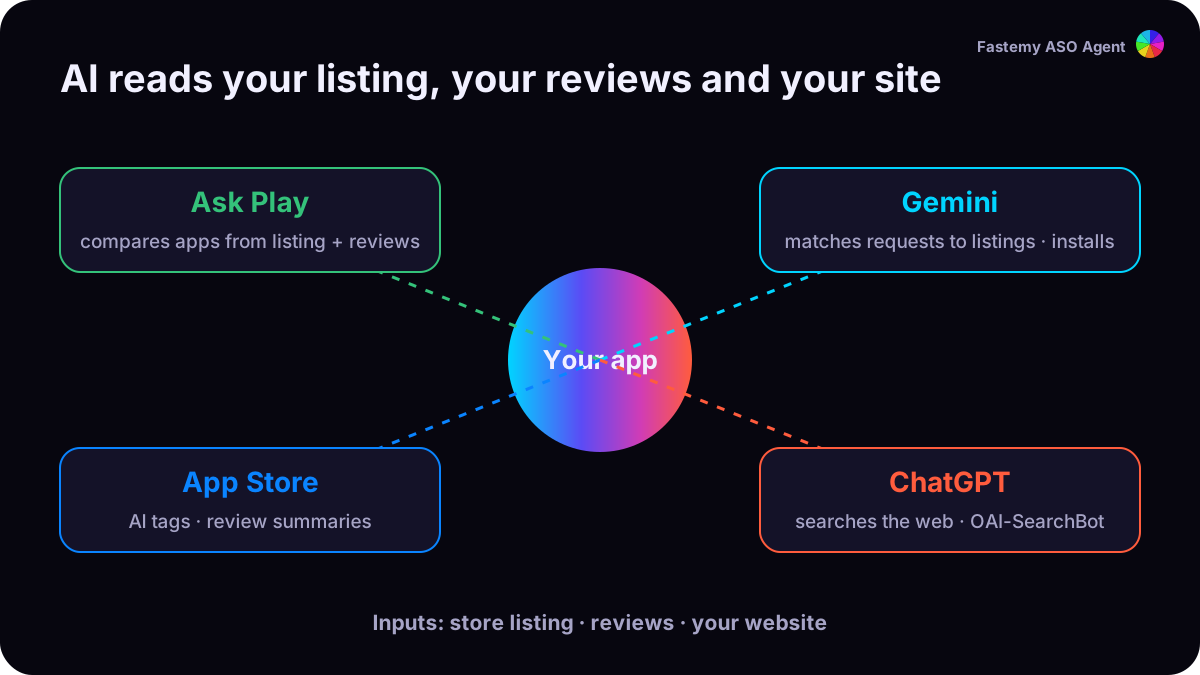
App discovery has a new layer: assistants that answer “what’s the best app for…?” Each one reads things you already control.
1. Ask Play reads your listing and your reviews
Google introduced Ask Play in May 2026: an AI layer that turns Play search into a conversation and recommends apps.1 Since October, it builds side-by-side comparisons by summarizing your store listing and user reviews, for example on subscription models or offline use.2
Do: state the facts people compare in plain words (price model, offline, platforms) in your description, and earn reviews that mention your main use case.
2. Gemini matches requests to listings
Gemini matches a request to your store listing and key features, so people can install in one tap; Google reports Gemini drove over 6 million installs in about two months (its internal data for 19 May to 31 July 2026).2 Google’s advice: keep listings and events fresh and upload high-resolution media.2
3. The App Store writes tags and summaries with AI
Apple generates app tags in search from your metadata with large language models,3 summarizes reviews the same way,4 and now shows Personalized Collections with App Notes that explain why an app is recommended (starting in US English).5 Accurate, specific metadata gives those systems better material.
4. ChatGPT answers from the web
ChatGPT search reads the web. OpenAI says sites that block OAI-SearchBot aren’t shown in ChatGPT search answers.6 Give your app a page on your own site, in server-rendered text: what it does, who it’s for, price, platforms, and links to both stores. Google says no special files or markup are needed for its own AI features.7
5. Measure it
Ask the assistants the questions your users ask, several times, and record whether your app is named. GEO Asked Agent, Fastemy’s free GEO tool, runs that check in your own ChatGPT, Claude or Google AI Mode.